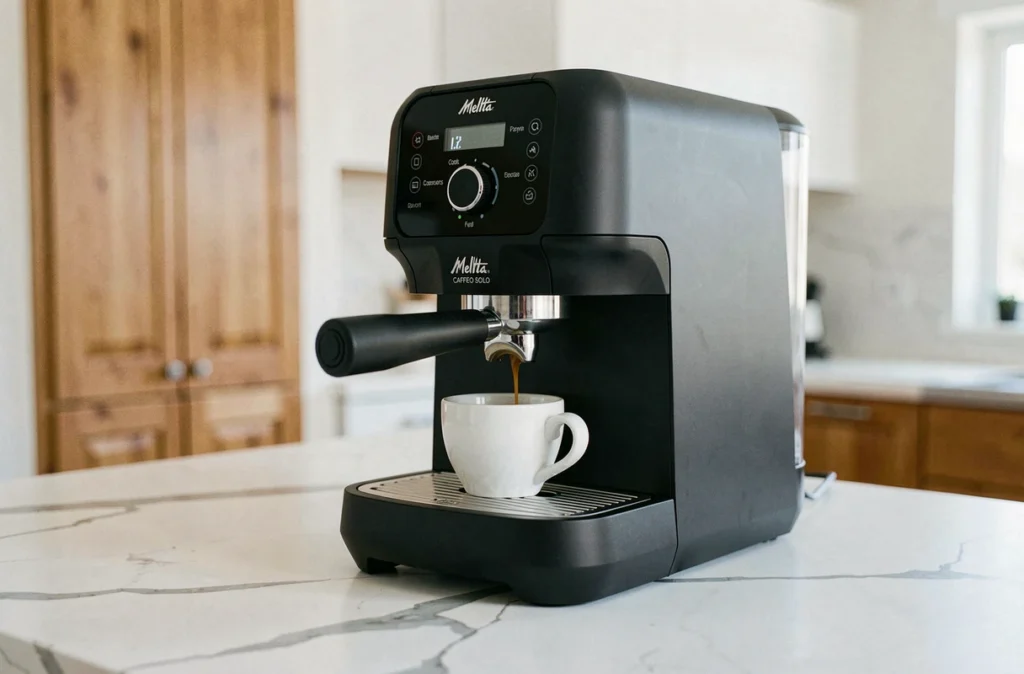
When you take the Melitta Caffeo Solo E950-222 out of its box, the first instinct is often to plug in the machine and press the power button. The result: a blinking light, an incomprehensible message, and coffee that doesn’t flow. Starting this compact bean machine follows a precise order, and skipping any step results in a failed cup or premature maintenance.
Setting the water hardness on the Caffeo Solo: the step everyone skips
Before even filling the tank, the machine requires you to configure the water hardness. This information can be found on your water supplier’s website or with a test strip, often provided with the device.
This setting determines how often the Solo will request descaling. If you leave the default value while the water is hard, the machine will trigger the descaling cycle too late, and limescale will have already begun to clog the internal circuit. Conversely, with soft water, a setting that is too high will result in unnecessary descalings.
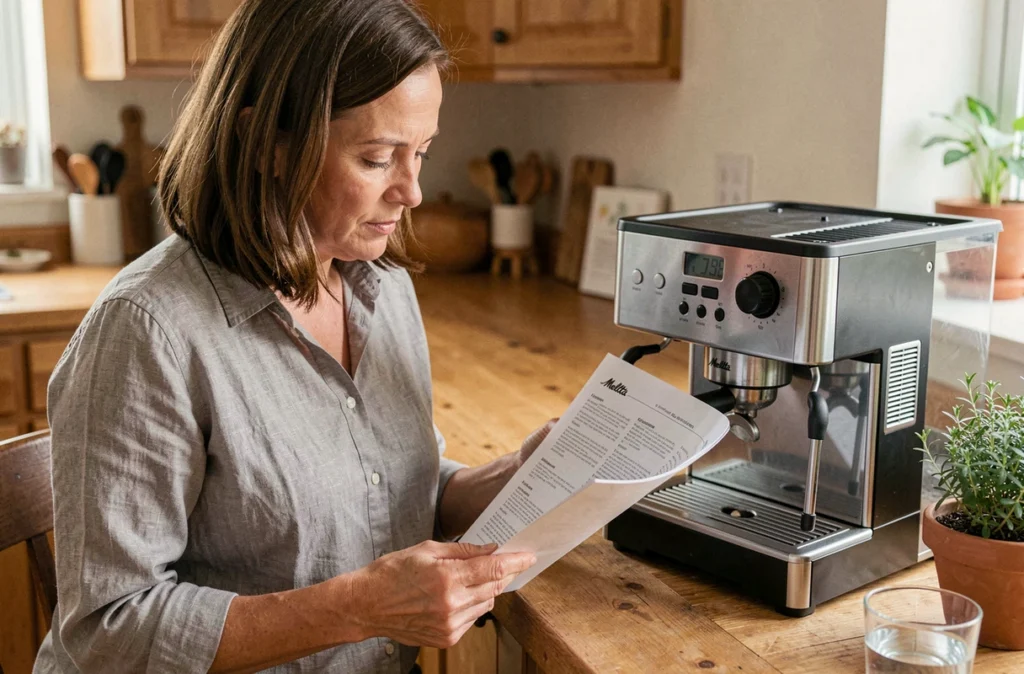
You can access the setting via the control panel by holding down the dedicated button. The manual for the Melitta Caffeo Solo E950-222 details the step-by-step procedure, with the correspondences between hardness levels and adjustment positions. Configuring the water hardness protects the hydraulic circuit in the long term.
First startup and filling: beans, water, rinsing
Once the hardness is set, it’s time to get practical. The water tank is removed from the back. Fill it with cold water, never hot or sparkling water, as this would damage the seals.
Load the bean container without blocking the grinder
The bean compartment is located on top. Pour in whole coffee beans, avoiding caramelized or oily coffees that clog the grinder faster than regular roasts. Oily beans clog the grinding mechanism and can cause a mechanical blockage.
The grind adjustment knob, accessible inside the container, should only be turned when the grinder is running. Turning it while stopped may distort the calibration.
Initial rinsing cycle
Upon first startup, the machine automatically initiates a rinse. You need to place a container under the coffee outlet and under the steam conduit. This cycle purges air from the circuit and prepares the brewing group. As long as this rinse is not completed, no drink can be prepared.
Preparing coffee and adjusting the cup result
The Caffeo Solo E950-222 is designed to prepare coffee and espresso, without an automatic milk frother. Press once for a small coffee, twice for a large one. The amount of water per cup is adjustable via the volume button.
The result in the cup depends on three variables that can be adjusted:
- The grind size, adjustable via the knob in the bean container (only when the grinder is running): finer gives a stronger coffee that flows more slowly.
- The amount of ground coffee per cup, adjustable on the control panel: increasing the dose enhances the body without changing the water volume.
- The water volume per cup, adjustable by holding the brew button: you can lengthen or shorten the drink according to taste.
A coffee that flows too quickly and lacks body indicates a grind that is too coarse or a dose that is too low. A coffee that drips indicates a grind that is too fine. Adjusting grind and dose together yields a balanced result.
Regular maintenance of the Melitta Caffeo Solo: cleaning and descaling
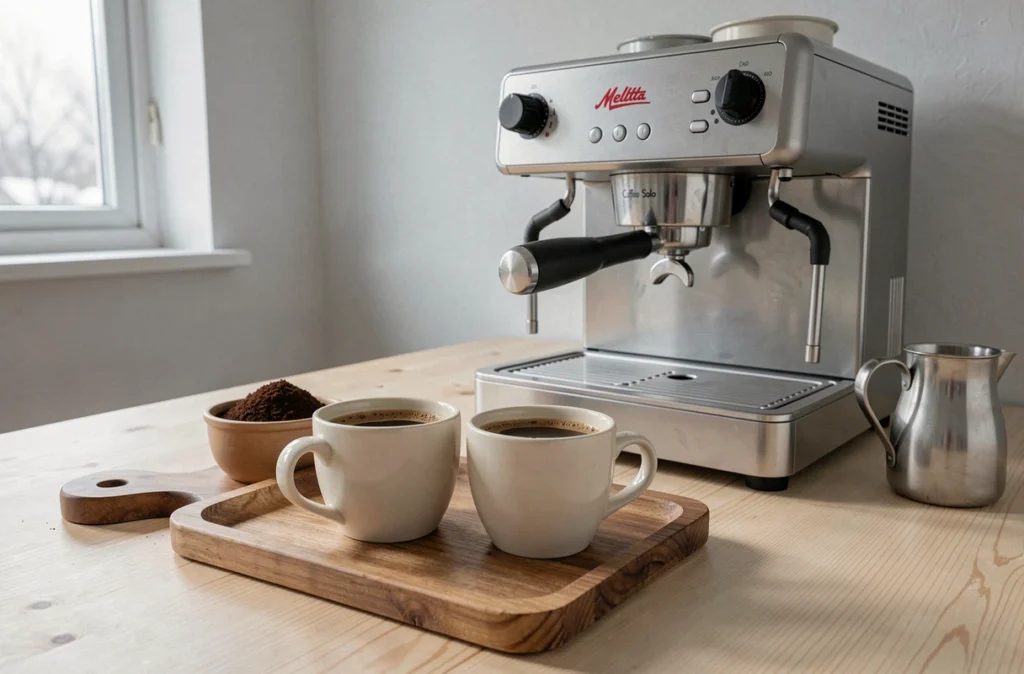
The Solo includes an automatic cleaning program and a descaling cycle. The two are distinct and do not replace each other.
Cleaning the removable brewing group
The brewing group is removed through the right side hatch, with the machine turned off. Rinse it under clear water, without dish soap or dishwasher. This operation removes coffee residues that accumulate after each extraction.
The manufacturer recommends a weekly frequency for daily use. In practice, if you prepare several coffees a day, rinsing the brewing group twice a week prevents the buildup of greasy deposits and rancid odors.
Descaling cycle: do not improvise
When the descaling light comes on, the machine refuses to prepare coffee until the cycle is initiated. Use the liquid descaler recommended by Melitta, poured into the water tank according to the proportions indicated in the manual.
The cycle lasts about twenty minutes. Do not interrupt it, even if the machine seems inactive between phases. Interrupting it may leave acidic descaler in the circuit, which alters the taste of subsequent coffees and can damage the seals.
- Remove the water filter before starting the descaling, or risk damaging the filter cartridge.
- Prepare a container of at least one liter under the spout to collect the rinsing water.
- After the cycle, initiate two manual rinses with clear water to eliminate any traces of product.
Grounds container and drip tray
The grounds container collects used coffee pucks. The machine signals when it is full, but it is more hygienic to empty it daily. The drip tray, located under the grid, collects residual water. A red float appears when it overflows, indicating that you have waited too long.
Common breakdowns and limitations of the device
User feedback reports grinder blockages after several years of use, often related to overly oily beans or a lack of maintenance of the brewing group. Regular maintenance remains the best prevention against mechanical breakdowns.
For spare parts, compatibility varies depending on the exact model of the device. Melitta lists components for the Caffeo Solo range, but you must check that the part corresponds to the E950-222 variant before ordering. The Solo does not have an integrated milk frother or automatic cappuccino mode: it is a machine deliberately focused on black coffee, not a versatile model.
When an unknown light comes on or abnormal behavior persists after cleaning and descaling, contacting Melitta’s customer service remains the most reliable course of action. Attempting to disassemble the screwed covers of the casing voids the warranty and exposes you to electrical risk.