The answer lies within a range: between 1,300 and 1,500 steps to cover one kilometer on flat terrain, at a moderate pace. This figure, echoed by most conversion tools and health websites, masks a more nuanced reality. The stride length varies according to height, gender, age, terrain type, and walking speed. Understanding these variables allows for a reliable estimate, much more useful than a single number.
Stride Length and Height: The Factor That Averages Overlook
The number of steps per kilometer primarily depends on stride length, which is correlated with the height of the walker. A person over one meter eighty covers more distance with each step than someone one meter sixty. The actual range extends from about 1,100 steps for the longest strides to nearly 2,000 steps for the shortest.
Average-height women take significantly more steps than men for the same distance, a point rarely explained in content that relies solely on the generic range. Knowing how many steps for 1 km thus requires knowing one’s own stride, rather than relying on a universal figure.
To estimate stride length without equipment, the simplest method is to walk a known distance (a twenty-meter hallway, for example) and count the steps taken. Dividing the distance by the number of steps gives a usable average stride. On flat terrain, at a normal pace, this value remains relatively stable from one walk to another.
Terrain, Speed, and Pace: What Affects the Counter
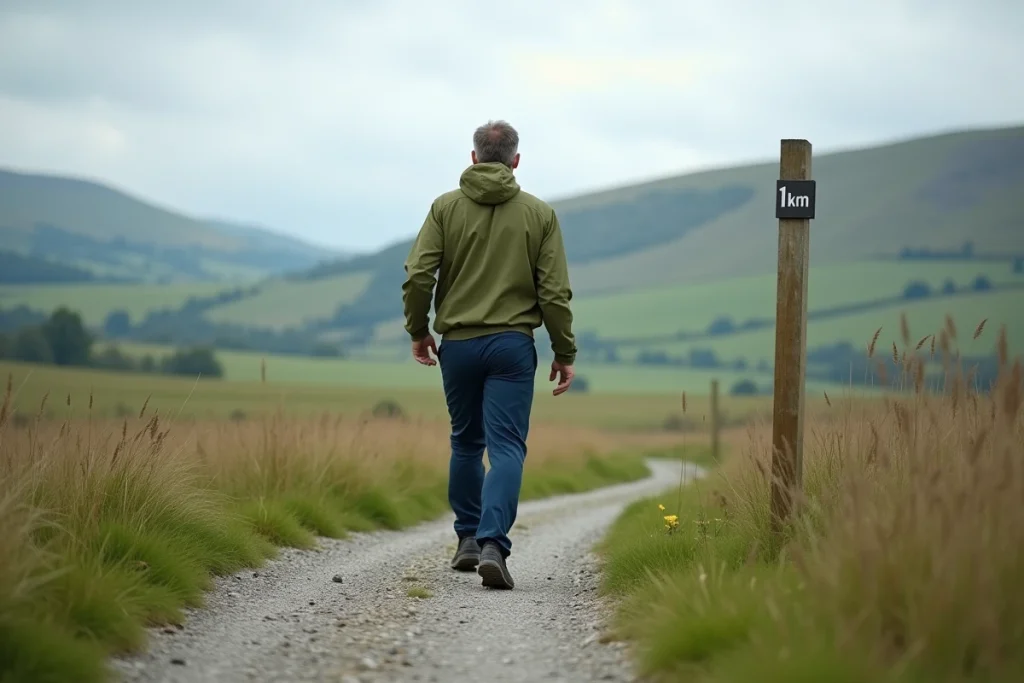
Walking on an urban sidewalk and progressing on a sloping hiking trail do not engage the same mechanics. On rough terrain, the stride naturally shortens to maintain balance. The number of steps per kilometer then notably increases compared to a flat surface.
Walking speed plays a similar role. At a fast pace, the stride lengthens: the walker covers each kilometer with fewer steps. At a slow pace, during a stroll or rehabilitation, the stride shortens and the counter rises.
Variables That Alter the Number of Steps per Kilometer
- The height of the walker: the main variable, it determines the natural length of the stride. The gap between a short person and a tall person can exceed several hundred steps per kilometer.
- The type of terrain: sloping paths, sand, gravel, or smooth asphalt alter the biomechanics of walking and shorten or lengthen the stride.
- Speed and walking intention: brisk walking, leisure walking, or Nordic walking produce very different strides.
- Age and physical condition: seniors and individuals in rehabilitation often adopt shorter strides, pushing the number of steps above the average.
- Weight and footwear: a heavy backpack or rigid shoes alter posture and reduce the amplitude of each step.
The Benchmark of 1,350 Steps per Kilometer: Practical Value or Misleading Approximation
Some recent conversion tools use 1,350 steps per kilometer as a practical standard to simplify daily calculations. This figure corresponds to a stride of about 74 centimeters, a median value for an average-height adult walking at a moderate pace.
This benchmark value works well for everyday use: estimating the distance traveled with a pedometer, converting steps into kilometers after a walk, or setting a daily walking goal. However, it loses accuracy as the walker’s profile deviates from the average.
For a hiker preparing for a trek, a patient in rehabilitation, or an athlete calibrating their training, measuring one’s own stride remains the only reliable approach. The available data do not allow for a universal figure applicable to all profiles.

Daily Distance and Health: Beyond the Number of Steps
The question of the number of steps per kilometer often arises in a health context. The goal of 10,000 steps per day, popularized since the 1960s, is not based on an initial scientific study. Its origin dates back to a Japanese advertising campaign for a pedometer whose needle simply returned to zero after 10,000 steps.
More recent studies have observed that adults walking 8,000 steps per day or more show better health indicators than those who walk less. This represents, depending on stride length, between five and six kilometers of daily walking.
What the Number of Steps Doesn’t Tell
The step counter provides no information on the intensity of the effort or the regularity of the practice. Walking 8,000 steps in one hour at a brisk pace does not have the same physiological effect as accumulating them over an entire day through small movements.
Pace, the duration of continuous walking sessions, and regularity over the week count just as much, if not more, than the raw number of steps. A pedometer gives a useful order of magnitude but does not replace an overall assessment of physical activity.
The figure of 1,300 to 1,500 steps per kilometer remains a solid benchmark for most adults walking on flat terrain. As soon as height, terrain, or pace deviates from the average, measuring one’s stride over a known distance yields a much more usable result than a generic estimate. The pedometer remains a valuable tracking tool, provided it is calibrated with one’s own data.