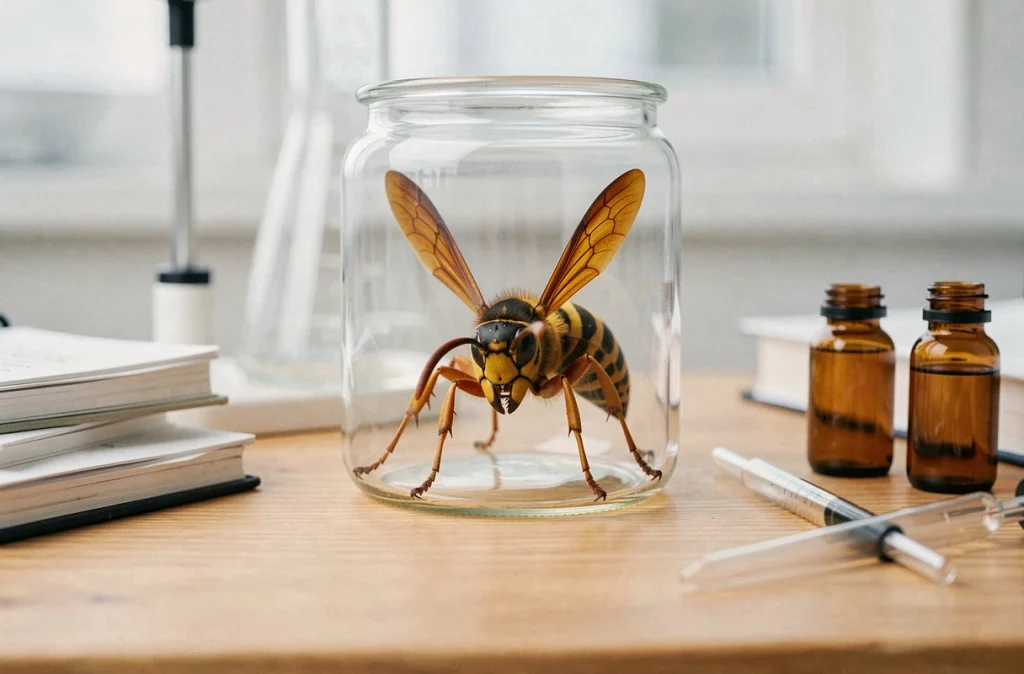
The venom of Vespa mandarinia and Vespa soror concentrates cytolytic peptides whose pharmacological potential far exceeds emergency toxicology. Recent publications in venom biochemistry reposition these compounds as therapeutic candidates, at a time when venom immunotherapy for hymenopterans remains limited to European species due to the lack of standardized preparations for Asian giant hornets.
Peptides from giant hornet venom: biochemical profile and pharmacological targets
Mastoparan, the predominant amphipathic peptide in the venom of Vespa mandarinia, acts by directly destabilizing cell membranes. This property, responsible for intense pain and local tissue necrosis, is of interest to oncological research for its ability to permeabilize the membranes of tumor cells resistant to conventional chemotherapies.
We observe that recent work focuses on the membrane selectivity of modified mastoparan. By synthesizing analogs with optimized amino acid sequences, several teams aim to maintain lytic activity on cancer cells while reducing toxicity on healthy cells. The principle relies on the difference in lipid composition between healthy and tumor membranes, with the latter exhibiting a higher proportion of phosphatidylserine on the outer leaflet.
Studying the sting of the giant hornet from this pharmacological angle allows us to understand why pure toxicology is no longer sufficient to describe these molecules. The venom also contains phospholipases, serine proteases, and neurotoxic peptides whose synergistic interactions amplify the inflammatory response, but also provide numerous avenues for the development of anti-inflammatory or antimicrobial agents.
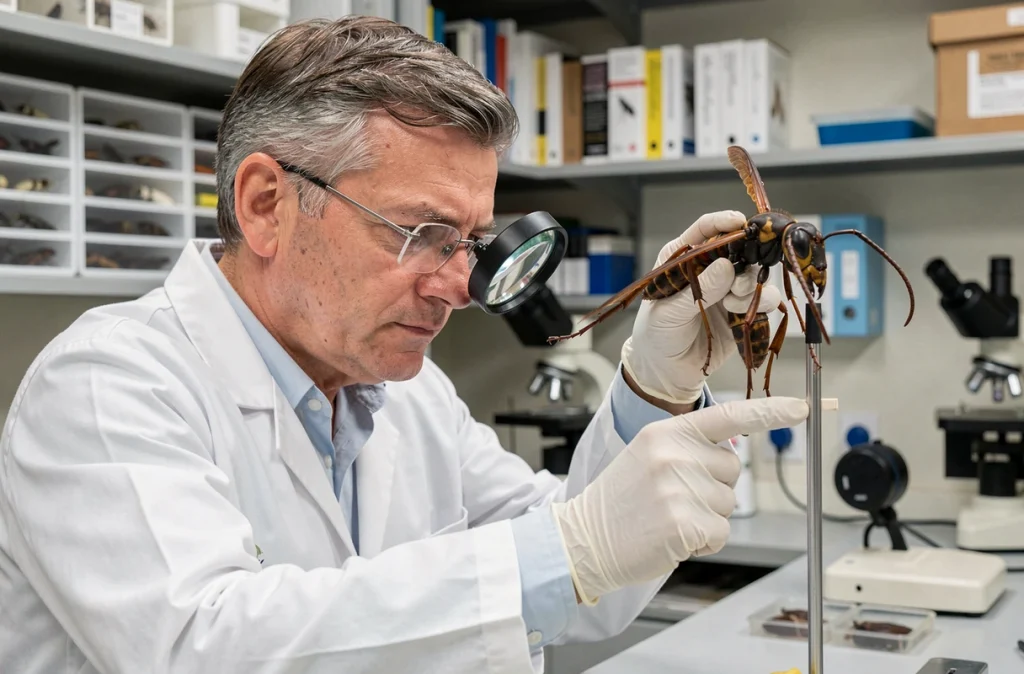
Immunotherapy with hymenopteran venom: the giant hornet lock
Immunotherapy with venom remains the only long-term treatment for hymenopteran allergy. Desensitization protocols, spread over three to five years, rely on the injection of increasing doses of purified venom. They permanently modify the immune response in patients who have experienced a systemic reaction after a wasp or bee sting.
The problem is technical. Standardized commercial preparations do not yet exist for Vespa mandarinia or Vespa soror. The number of documented clinical cases in Europe and North America remains too low to justify the marketing of a dedicated extract, while the methodology and production infrastructure are perfectly transferable.
This situation creates a clinical paradox: a patient stung by a giant hornet and developing anaphylactic shock does not benefit from the same desensitization pathway as a patient allergic to Vespula venom. We recommend in these cases an allergological assessment with cross-skin tests, as there is partial cross-reactivity between Vespinae venoms, but it does not guarantee complete protection.
Limits of cross-reactivity between species
The major allergens of European hornet venom (Vesp c 1, Vesp c 5) share variable sequence homology with their equivalents in Vespa mandarinia. A patient desensitized to Vespa crabro venom may exhibit partial tolerance to a giant hornet sting, without this protection being predictable on a case-by-case basis.
The development of recombinant allergens specific to the giant hornet represents the most promising avenue to overcome this lock. Producing recombinant proteins rather than crude extracts would allow for the standardization of doses and precise targeting of the IgE responsible for sensitization.
Antimicrobial applications of hornet venom peptides
The emergence of multidrug-resistant bacteria drives research towards animal-derived antimicrobial peptides. Mastoparans and crabrolins isolated from hornet venom exhibit broad-spectrum bactericidal activity, including against methicillin-resistant Staphylococcus aureus strains.
The mechanism of action fundamentally differs from that of conventional antibiotics:
- Cationic peptides insert into the bacterial membrane through electrostatic interaction, forming pores that cause cell lysis within minutes.
- This mode of action makes the development of resistance much slower, as the bacterium would need to modify the overall composition of its membrane, a change that is metabolically costly.
- Peptides can be combined with conventional antibiotics at sub-inhibitory doses, creating a synergistic effect that restores the effectiveness of molecules that have become obsolete in monotherapy.
The main difficulty remains in vivo stability. Venom peptides are rapidly degraded by serum proteases. Current strategies include cyclization, substitution with non-natural amino acids, or encapsulation in lipid nanoparticles to prolong plasma half-life.
Systemic toxicity of giant hornet venom: mechanisms and advanced management
Beyond the IgE-dependent allergic reaction, the venom of Vespa mandarinia causes direct dose-dependent toxicity. Multiple stings, even in a non-allergic subject, can lead to rhabdomyolysis and acute renal failure due to the accumulation of myoglobin in the renal tubules.
The management of these severe envenomations requires aggressive rehydration and urine alkalinization to prevent tubular precipitation. Plasmapheresis protocols, tested in some Asian centers for cases of massive stings, aim to eliminate circulating toxic components before they reach target organs.
Towards specific antivenoms
Antivenoms dedicated to giant hornets do not exist in current clinical practice. The production of neutralizing antibodies, modeled after snake antivenoms, faces the complexity of the peptide mixture and the development cost for a rare indication in the West. Approaches using monoclonal antibodies targeting phospholipases A1 and A2 from the venom represent a more realistic avenue, as they allow for the neutralization of the most toxic components without requiring a complete polyvalent serum.
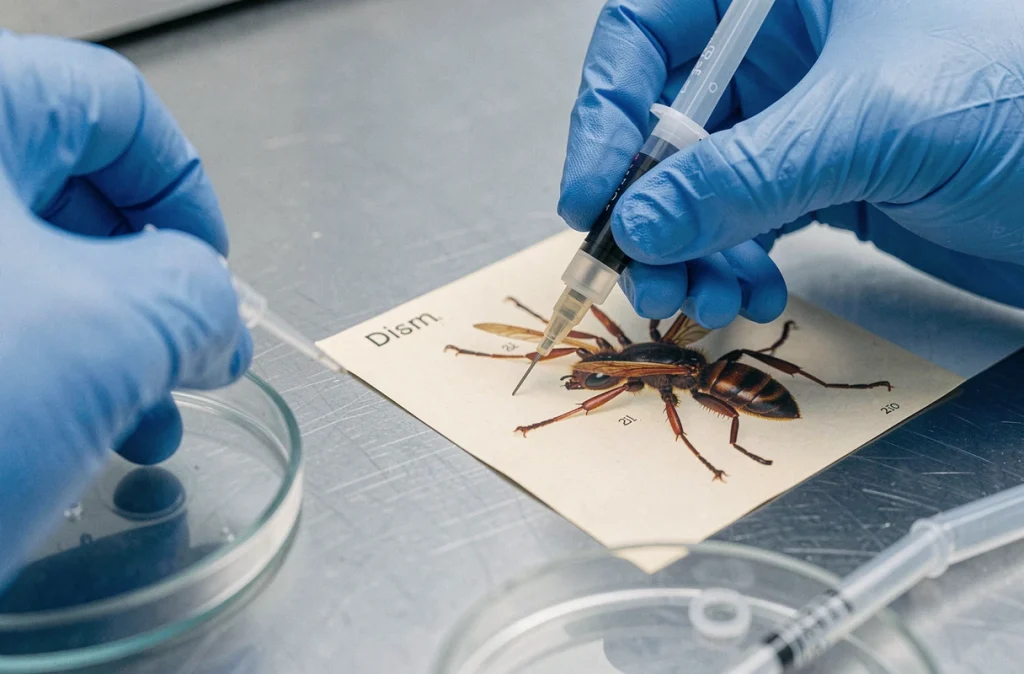
Research on giant hornet venom lies at the intersection of toxicology, allergology, and antimicrobial pharmacology. The peptides that make these stings so dangerous are precisely those that could fuel the next generation of anticancer agents, membrane-lytic antibiotics, and targeted desensitization protocols. The bottleneck is no longer conceptual; it is industrial: standardizing the production of these molecules on a therapeutic scale.