Jamaica is among the most popular Caribbean destinations, but the linguistic question there is more complex than a simple “they speak English.” The island operates with two parallel linguistic systems, one official and the other rooted in the daily lives of the vast majority of the population. This coexistence, far from being anecdotal, structures social relations, the educational system, and even current political debates.
Standard Jamaican English and Creole: two languages, not one
English is the official language of Jamaica, used in administration, courts, written media, and formal education. It is a standard Jamaican English close to British English in its grammar and vocabulary, a direct legacy of colonization. Government documents, laws, and institutional communications are written in this English.
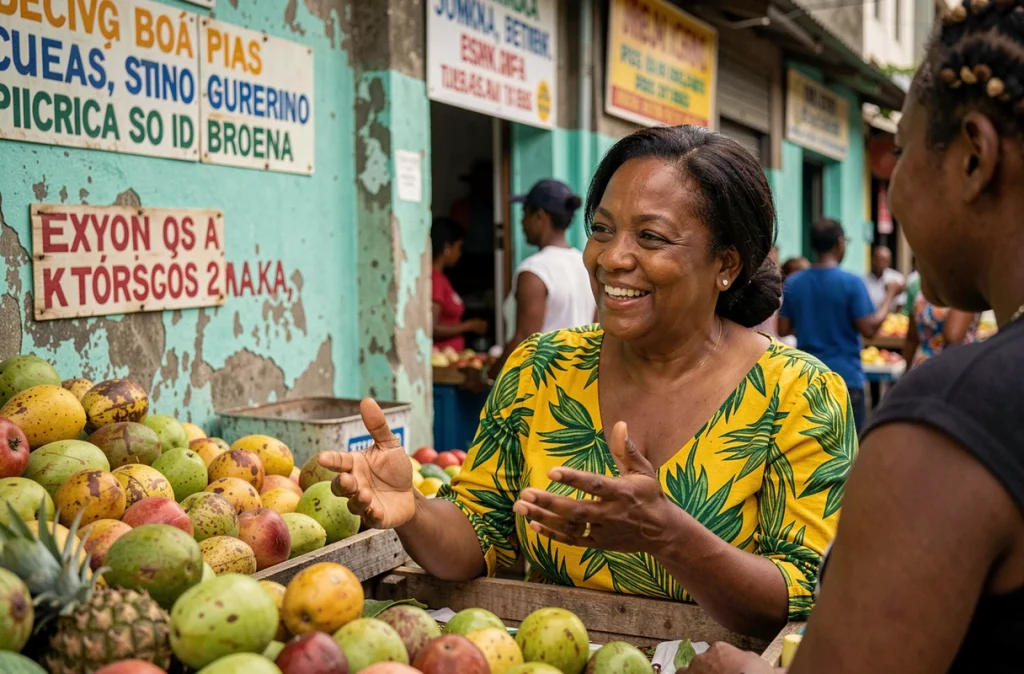
In parallel, the language that most Jamaicans use at home, in the street, at markets, and in informal conversations is Jamaican Creole, locally called patois or patwa. This creole is not a “badly spoken” English or a degraded dialect. It has its own grammar, phonology, and a lexicon that blends English roots with West African, Spanish, and Portuguese influences.
For those who wish to delve deeper into what language is spoken in Jamaica, the distinction between these two systems is the starting point. A traveler who speaks English will be understood everywhere, but understanding the surrounding patois requires a trained ear.

African and colonial roots of Jamaican patois
Jamaican Creole formed between the 17th and 18th centuries, in the context of sugar plantations. The enslaved people deported from West Africa spoke various languages (akan, igbo, yoruba, among others). To communicate with each other and with British colonists, a pidgin developed, combining an English lexical base with grammatical structures and phonetic elements from these African languages.
This pidgin stabilized over generations to become a fully-fledged creole. Some traces of the earlier Spanish occupation before the English conquest of 1655 also remain in the vocabulary, particularly in certain place names and agricultural terms.
The structure of patois differs significantly from English in several ways:
- The frequent absence of verbal conjugation in the English sense, with tense marked by particles placed before the verb (for example, “did” for the past, “a go” for the future)
- A simplified pronoun system where “mi” replaces “I” and “me,” and “dem” serves as the plural
- Idiomatic expressions directly modeled on West African languages, such as “mi belly full” to express fullness
This is not approximate English. Patois follows coherent and documented linguistic rules, notably through the Cassidy-JLU writing system, adopted in 2002 to standardize the spelling of Jamaican Creole.
Official status of patois: a political and identity debate
English remains the only de facto official language in Jamaica. Patois, although spoken by nearly the entire population in daily life, has never obtained constitutional status. This situation creates a gap between the linguistic reality of the country and its institutional framework.
The educational system illustrates this tension. Teaching is conducted in standard English, while most children arrive at school speaking patois as their mother tongue. Several linguists and activists associate this policy with persistent educational inequalities, as students from rural or lower-income backgrounds are disadvantaged by an education delivered in a language that is not their everyday one.
Activist movements, more visible in recent years, articulate the official recognition of patois with issues of symbolic decolonization and Black identity. The Jamaican diaspora, particularly in the UK and North America, actively participates in these debates online and in cultural media.
Patois in the digital space
A recent turning point marked the recognition of Jamaican Creole outside academic circles. Google Translate integrated Jamaican patois in June 2024, during a massive addition of 110 new languages to the platform. This inclusion in a tool used by hundreds of millions of people gives patois unprecedented technological visibility.
This advancement also raises questions. The existence of a standardized writing system (the Cassidy-JLU) facilitates automatic processing, but feedback from the field varies on the current ability of these tools to capture the nuances of the creole as it is actually spoken in the different parishes of the island.
Understanding the Jamaican linguistic continuum
Reducing the situation to “official English, informal patois” would be oversimplifying. Jamaica operates on a linguistic continuum between creole and English, where each speaker navigates between several registers depending on the context. The same person can express themselves in an English close to the standard during a work meeting, shift to an intermediate mix in a relaxed conversation with colleagues, and use a dense patois at home.
This phenomenon, called “code-switching” by linguists, is not specific to Jamaica, but the island provides a particularly marked example. Social prestige remains associated with standard English, while patois carries a strong identity and emotional weight. Speaking patois in certain professional contexts can still be perceived as a lack of education, a stigma that language activists are precisely seeking to combat.
For a traveler, this reality means that English will work in all tourist exchanges (hotels, restaurants, transportation). However, stepping outside the marked circuits, listening to dancehall, or engaging in a conversation at a market in Kingston exposes one to a patois that may seem opaque even to a fluent English speaker.
The Jamaican linguistic situation remains a shifting terrain. English dominates institutions, patois dominates real life, and the boundary between the two continues to shift with generations, migrations, and digital tools that increasingly normalize the written existence of the creole.