Home furniture delivery and assembly is not just a simple transport followed by assembly. Behind this service lie logistical choices, contractual clauses, and varying levels of service from one brand to another. Here, we break down the technical points to master before confirming an order.
Access constraints to the home: the parameter that buyers underestimate
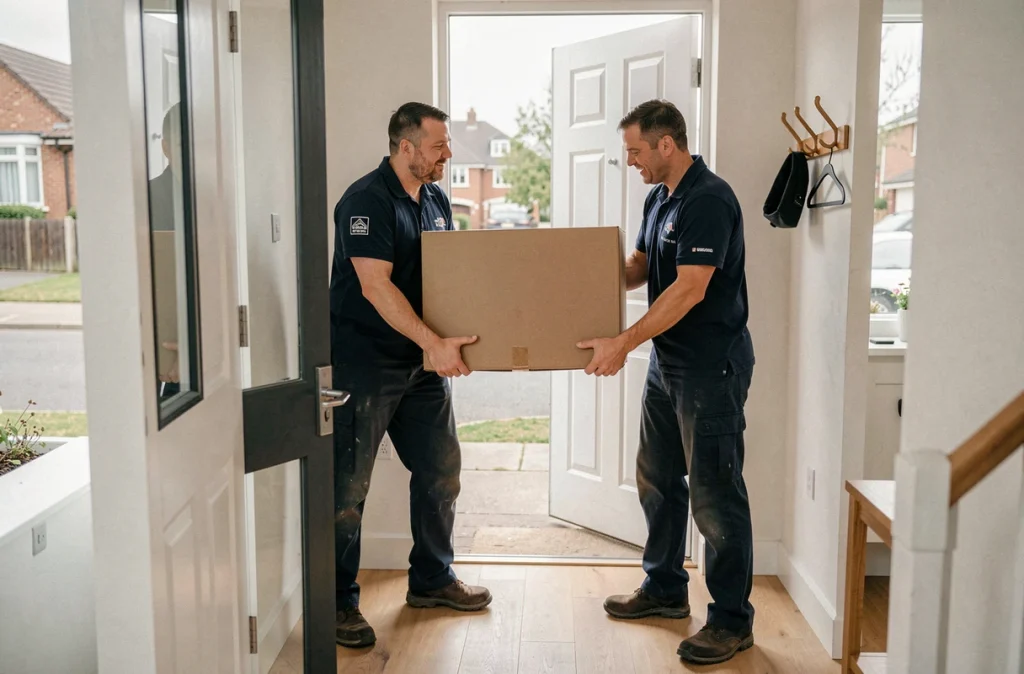
The majority of disputes related to furniture delivery stem from a last-mile delivery issue. Staircase width, door dimensions, and the presence or absence of an elevator: these factors determine the feasibility of the service.
Before placing any order, we recommend taking three measurements: the minimum width of the narrowest passage between the truck and the destination room, the ceiling height in the staircase, and the turning angle at landings. A corner sofa with a seat depth exceeding 90 cm will not pass through a standard 73 cm door without partial disassembly.
Some brands charge an extra fee for passage through a window or balcony via a lift. Others outright refuse delivery if access conditions are not met, without refunding the fee. Check the delivery refusal clauses before paying, especially for bulky packages with combined dimensions exceeding two meters.
On this point, the delivery and assembly service at But explicitly distinguishes between “delivery to the door” and “delivery to the room of your choice,” each with its own eligibility conditions and pricing.
Service levels for delivery and assembly: decoding the packages
Commercial vocabulary can obscure understanding. “Comfort delivery,” “premium delivery,” “standard delivery”: each brand defines these terms in its own way. Two services with the same name can cover radically different scopes.
Here are the tiers we systematically observe in the French market:
- Drop-off at the foot of the building: the carrier unloads the package on the sidewalk or in the lobby. No stair climbing, no unpacking. Often the cheapest option, sometimes free beyond a certain order amount.
- Delivery in the room with unpacking: the furniture is brought upstairs, taken out of its packaging, and positioned. The boxes are taken away. Assembly is not included.
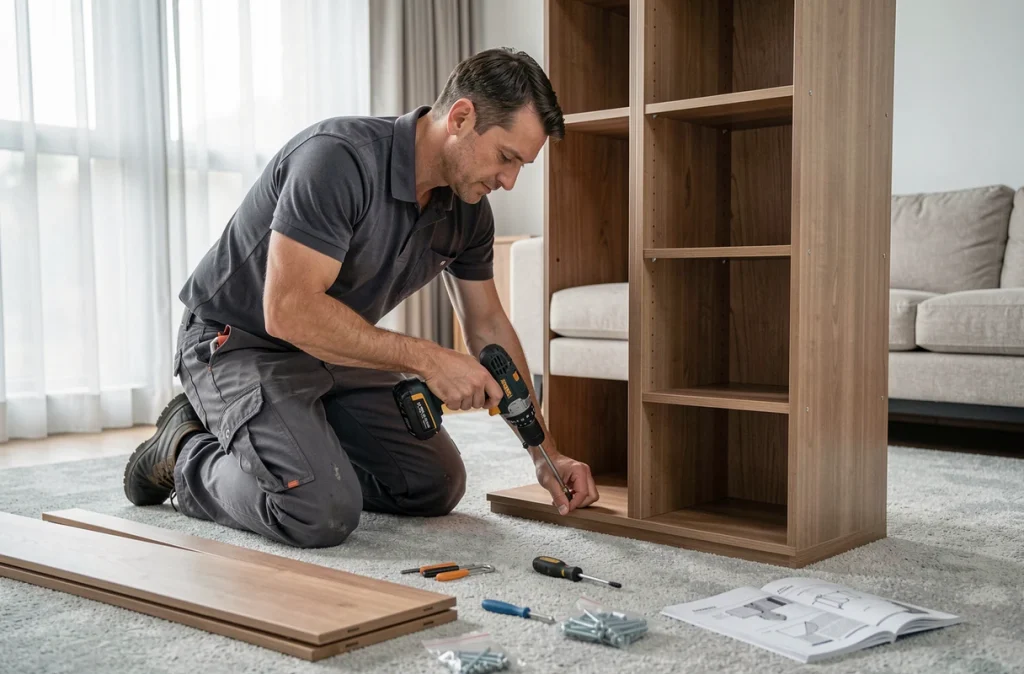
- Delivery with complete assembly: on-site assembly, setup for appliances, removal of all packaging. This is the only package that holds the provider responsible for the compliance of the assembly.
- Additional service for taking back old furniture: offered as an option by some brands, it requires that the old furniture be disassembled and accessible on the day of delivery.
A common trap concerns the geographical area. In mainland France, Corsica is often excluded from standard packages. Some islands (Oléron, Ré, Noirmoutier) are still serviced, but with extended delivery times.
Cost of home furniture assembly: what affects the bill
The hourly rate for an independent professional assembler is around a few dozen euros per hour. Matching platforms display introductory prices, but the final bill depends on variables that are rarely detailed in advance.
The complexity of the furniture weighs more than its size. A wardrobe with sliding doors, soft-close drawers, and integrated lighting takes an assembler much longer than a two-door wardrobe of equivalent dimensions. Kitchens and bathrooms, which require connections, fall under a separate installation service, often entrusted to a qualified craftsman.
The number of items to be assembled in a single intervention lowers the unit cost. We recommend grouping orders to negotiate a global package, especially during periods of market contraction when brands seek to secure their sales with attractive services.
Negotiation and free assembly
For a complete furnishing project, delivery and assembly are the budget lines that are easiest to negotiate. Their actual cost to the store is significantly lower than the price displayed to the customer. When making a bulk purchase (living room, bedroom, kitchen), it is common to obtain partial or total free delivery and assembly.

Responsibility and recourse in case of damage during assembly
A professional assembler is liable for the results of their intervention. If a panel is drilled in the wrong place or if the floor is scratched during assembly, their insurance covers the damage, provided the service was ordered through a traceable channel.
Request a signed intervention slip mentioning the condition of the furniture after assembly. This document serves as proof in case of a subsequent claim. Without it, recourse to the retailer becomes much more complex.
When receiving a piece of furniture delivered in a package, check the condition of the packaging before signing the delivery slip. Any reservations must be noted precisely (“upper left corner dented,” not just “damaged package”). A vague reservation can be contested by the carrier.
Assembly by an individual or self-employed worker
Collaborative platforms connect you with assemblers of varying statuses. The European regulatory framework on platform work is evolving, with a directive aimed at clarifying the status of these workers. For the customer, the key question remains insurance: a self-employed worker must have professional liability insurance covering damages caused at your location.
The furniture market is undergoing a contraction phase that pushes brands and platforms to enrich their service offerings. This increased competition directly benefits the buyer, provided they compare actual services and not just marketing titles. A well-chosen delivery and assembly package secures the purchase, protects the furniture, and eliminates the risk of approximate assembly that compromises the product’s durability.