
The interior decoration market continues to grow, driven by an increasingly marked demand for personalization. Works of art hold a special place in this dynamic: they do not merely fill an empty wall but alter the perception of a space, its ambiance, and sometimes even its function. Choosing a piece for your interior requires considering aesthetic, technical, and practical criteria that go beyond mere love at first sight.
Technical constraints before purchasing a work of art for the home
Before thinking about style or color, the question of materials deserves attention. In a private setting, restrictions are less than in a public establishment. However, the environment of the room affects the longevity of the artwork.
A canvas exposed to a south-facing window will suffer accelerated degradation of pigments. Even high-quality digital printing inks fade under prolonged direct lighting. UV-protective glazing or positioning in indirect light preserves colors for several decades.
Humidity is another underestimated factor. A framed photograph without a mat, placed in a bathroom or an open kitchen, risks developing mold between the glass and the print. Aluminum works or prints on waterproof substrates withstand these environments better. To explore pieces suitable for different spaces in the home, the Fannylng Art website offers works designed to integrate room by room.
The weight of the artwork and the nature of the wall (drywall, concrete, stone) determine the fixing system. A large-format painting on a wooden frame can weigh several kilograms: an inappropriate anchor on hollow plaster can ultimately cause it to pull away.
Original work, reproduction, or limited edition: what each format implies
The distinction between these three categories is not just a matter of price. It involves perceived value, traceability, and the relationship with the artist.
- An original work (painting, sculpture, drawing) is a unique piece. Its price reflects the time of creation, the artist’s renown, and its rarity. It usually comes with a certificate of authenticity.
- A limited edition (screen print, lithograph, numbered photographic print) offers a compromise: the connection with the artist remains direct, the edition is controlled, and the price is accessible compared to an original.
- A reproduction (poster, print, unnumbered impression) has no collectible value. It serves a decorative role without any patrimonial pretension.
Online galleries have blurred these distinctions. Some platforms sell canvas prints presented as “paintings,” without specifying that they are unnumbered digital reproductions. Checking the edition mention, signature, and certificate remains the basic reflex before any purchase.
Wall decoration and visual coherence: combining artwork, space, and furniture
The most common mistake is to choose a work in isolation and then look for where to place it. The reverse approach works better: start from the room, its light, its volumes, and its existing furniture.
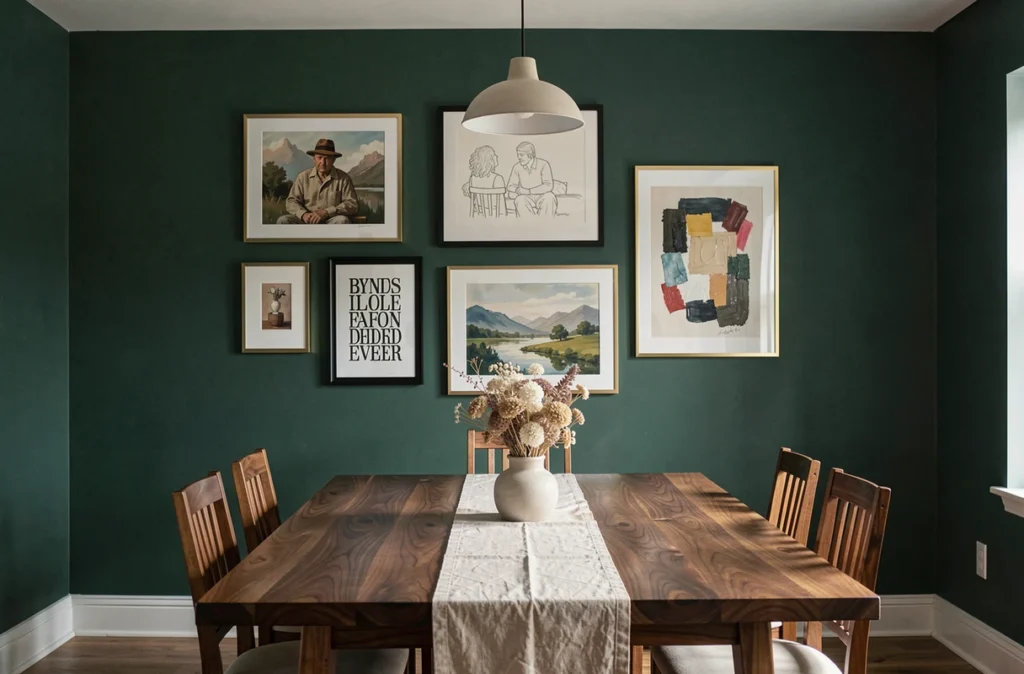
A large format in a small living room creates a powerful focal point, provided the rest of the furniture remains understated. Conversely, accumulating several small frames on a narrow wall gives an impression of disorder if the spacing and alignments are not well thought out.
The color palette of the artwork interacts with that of the room. A flat of bright color on a white wall creates a sharp contrast that draws the eye. The same work placed on a terracotta or forest green wall sees its impact diminish, even creating a visual conflict.

Hanging and staging
The standard hanging height places the center of the artwork at eye level, about 1.50 m from the floor. This rule, used in galleries, works in a hallway or a living room with low furniture.
In a living room where people are primarily seated (sofa, dining table), lowering the painting by a few centimeters aligns the view in a seated position. Dedicated lighting transforms a simple frame into a centerpiece: a directional wall sconce or a track of spotlights is enough to detach the artwork from the wall.
Art and personalized decoration: when pop or contemporary style changes an interior
Pop art style, with its bold colors and saturated contrasts, remains one of the most sought-after in interior decoration. Its visual effectiveness lies in its immediate readability: even from a distance, a pop artwork captures attention.
Field feedback diverges on this point: some decorators consider pop art a safe choice, easy to integrate into a modern living room, while others point out its tendency to “overwhelm” surrounding decorative elements if the format is too imposing.
Abstract contemporary art offers a more open alternative for interpretation. An abstract canvas adapts to the evolution of furniture because it does not fix a specific style. It ages with the space rather than against it.
Mixed media works (collage, resin, integration of wood or metal) add a tactile dimension that painting alone does not offer. They work particularly well in minimalist interiors where texture creates contrast.
Sculptures and three-dimensional art objects
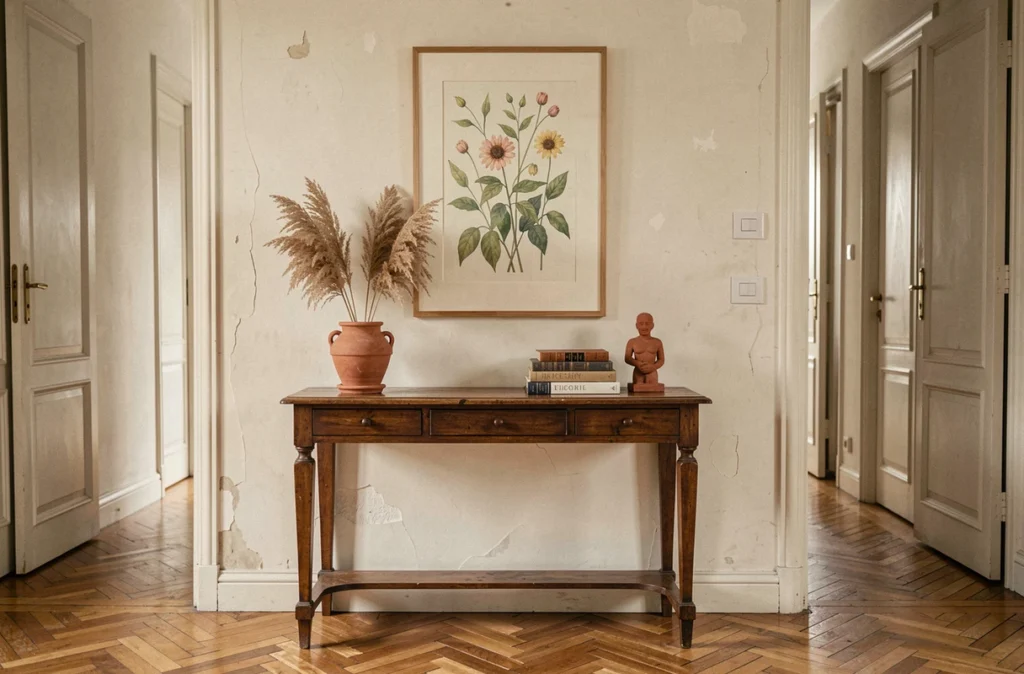
Wall decoration often monopolizes thought, but small and medium-sized sculptures bring a different physical presence. Placed on a console, a shelf, or on the floor, they introduce volume and break the flatness of a classic layout.
A sculpture interacts with natural light throughout the day, changing appearance depending on the angle of lighting. This is an advantage that no painting possesses.
Choosing a work of art for your interior is as much about technique as it is about taste. The medium, format, lighting, and hanging condition the result as much as the subject represented. A poorly lit or poorly sized painting loses much of its effect, regardless of its artistic quality. Taking the time to evaluate the space before selecting the work remains the most reliable method to achieve a lasting result.