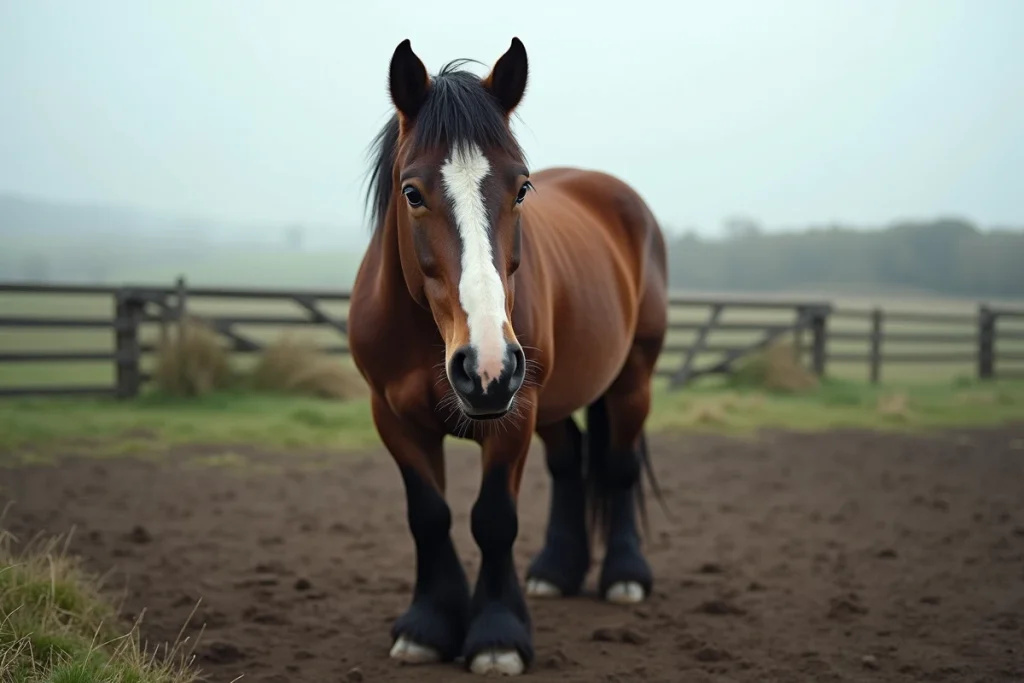
The Flehmen reaction alone explains a good part of the misunderstanding. When a horse curls its upper lip, stretches its neck, and inhales deeply, it activates its vomeronasal organ (Jacobson’s organ) to analyze pheromones or unusual smells. This posture, purely functional, produces a facial expression that the general public interprets as grotesque, even repulsive.
Viral clichés of “ugly horses” often capture this precise moment, without the caption ever mentioning the chemosensory mechanism at play.
Flehmen Reaction and Photographic Bias: Anatomy of an Ugly Horse
Jacobson’s organ is an auxiliary olfactory receptor located in the palate. In horses, it primarily serves to detect the reproductive state of peers, but also to explore unknown objects or animals. The associated posture – head raised, nostrils flared, upper lip curled – lasts a few seconds. A quick trigger is enough to freeze the image.
The problem is that this fraction of a second becomes the only representation of an animal on social media. A stallion in the midst of a Flehmen reaction looks like a caricature. Add a low-angle shot that distorts the proportions of the muzzle, and the “ugliest horse in the world” is born. To understand why the ugliest horse fascinates, one must first admit that most of these photos show normal behavior captured at the wrong moment.
Horses also display facial expressions related to stress or pain, sometimes confused with “ugliness.” A horse that flares its nostrils, contracts its orbital muscles, or excessively swishes its tail is showing discomfort. There’s nothing aesthetic about it, but nothing ugly either: it’s communication.
Conditioning and Curiosity of the Horse: Why the Animal Reacts So Much to Stimuli
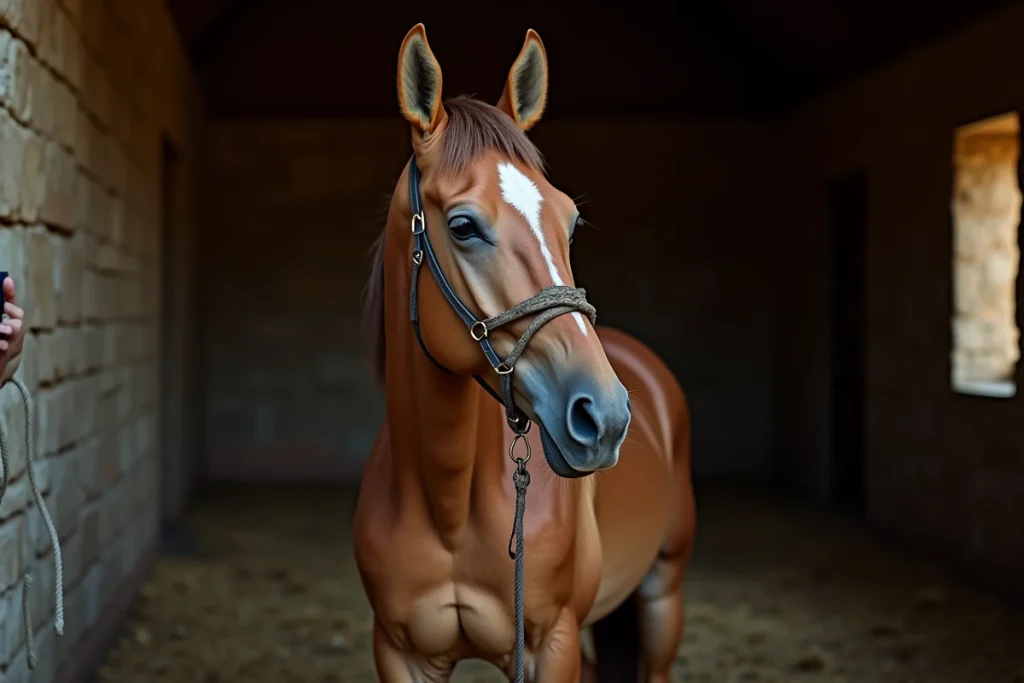
A horse labeled as “ugly” attracts human attention, but the opposite is equally true. The horse is a neophobic animal by nature, meaning it reacts strongly to novelty. An unknown object, a sudden noise, or a peer with an unusual phenotype triggers a sequence of investigation: cautious approach, nasal blowing, possible Flehmen reaction.
Léa Lansade, a researcher in equine ethology at INRAE, has extensively documented the cognitive abilities of horses and their responses to conditioning. The link between curiosity, fear, and learning is at the heart of equine behavior. A pony confronted with an unusual visual stimulus can oscillate between flight and exploration in a matter of seconds.
This reactivity explains why videos of “weird” horses perform so well online. The human viewer projects an emotion they recognize onto the animal: surprise, disgust, amusement. The horse, on the other hand, is merely executing a behavioral program inherited from its wild ancestors, where any visual anomaly could signal a predator.
Atypical Breeds and Aesthetic Norms in Horse Breeding
Morphological standards vary significantly from breed to breed. What the public perceives as “ugly” often corresponds to traits selected for a specific function.
- A pronounced convex muzzle (a “dished” profile) is typical of certain Iberian and draft breeds. It improves the clearance of the airways during exertion, but gives a silhouette that contrasts with the straight profile of thoroughbreds.
- The long, mobile ears of the Poitou donkey or the Mule, often mocked, increase sound capture area and thermoregulation in hot climates.
- An irregularly spotted or piebald coat, deemed “messy” by some enthusiasts, results from color genes (Tobiano, Overo) that do not affect the animal’s health or abilities.
In the professional field, we observe that horses labeled as ugly on social media rarely correspond to individuals in poor health. The majority simply exhibit phenotypes that deviate from the standards of equestrian sport, where the dominant model remains the Selle Français or the Warmblood with a “clean” profile.
Age, Shedding, and Conditions of Capture
A growing foal goes through phases of spectacular disproportions. The croup rises before the withers, the legs appear too long, and the head seems enormous. This stage, perfectly normal, lasts several months and generates photos that feed humorous compilations.
Seasonal shedding produces similar effects. A horse losing its winter coat appears patchy, with visible undercoat patches. Bad clipping remains the top generator of “ugly horses” on the Internet, far ahead of actual genetic anomalies.
Horse Vision and Human Perception: Two Incompatible Frameworks
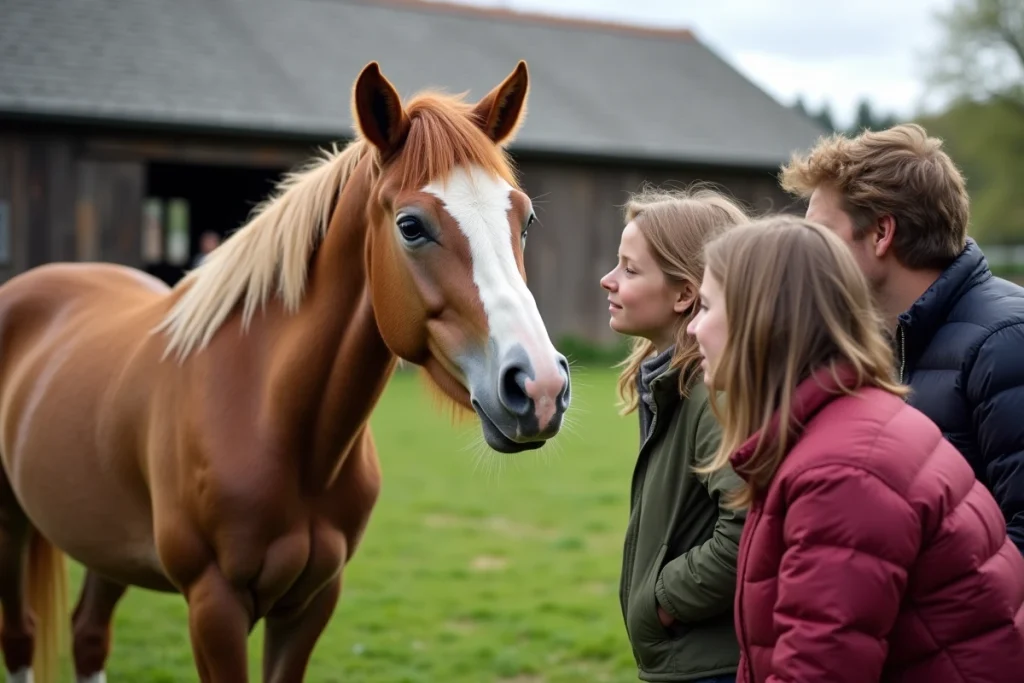
The horse has a nearly panoramic vision, with a visual field of about 340 degrees. Its color perception is dichromatic: it distinguishes blue and yellow, but not red or green. Its binocular vision zone, located straight ahead, is narrow.
This configuration means that the horse does not perceive its own reflection as a human would. The notion of “beauty” or “ugliness” has no relevance in its sensory universe. A horse does not know it is ugly. It reacts to smells, sounds, movements, not to aesthetic judgments.
The gap between human vision and equine vision is fundamental to understanding the viral phenomenon. We project our criteria of facial symmetry, proportion, and “normality” onto an animal whose perceptual system operates on radically different parameters. The buzz around the ugly horse speaks more about our relationship with appearance than about the animal itself.
The success of this content relies on a simple mechanism: the transgression of an expectation. The horse is culturally associated with nobility, elegance, and power. An individual that deviates from this image provokes an immediate contrast effect, conducive to sharing. The curiosity these animals evoke is not pure mockery: it is a form of fascination for the gap between the mental model and biological reality.