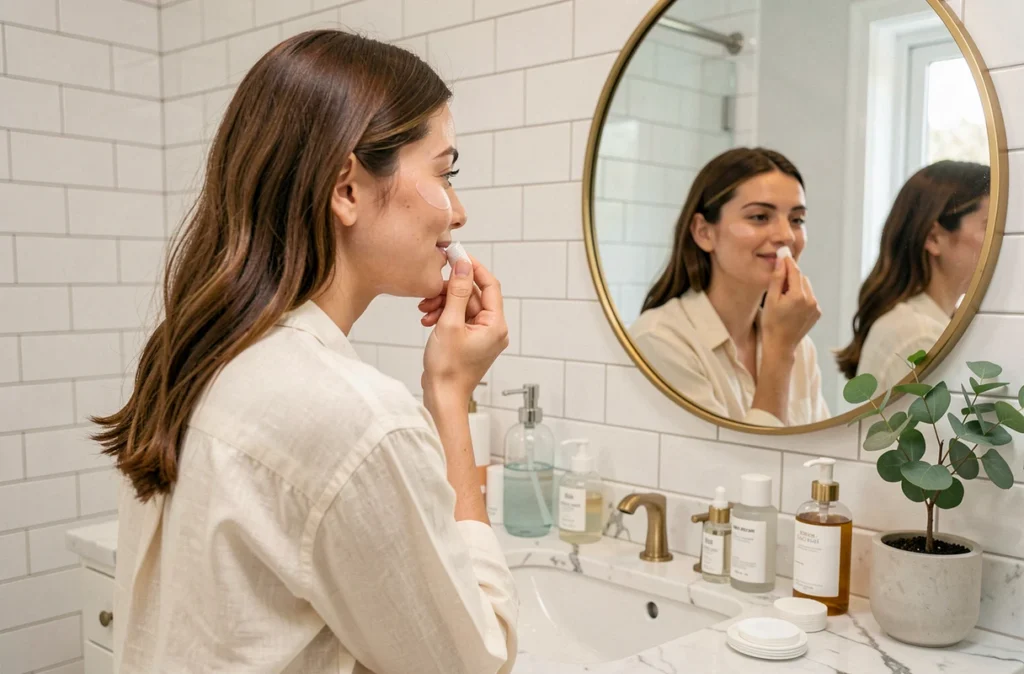
The French beauty market is undergoing a period of rapid changes. With the arrival of artificial intelligence in shopping habits, stricter regulations on commercial influence, and European restrictions on certain cosmetic ingredients, building a coherent beauty routine requires more vigilance than a few years ago. The topic goes beyond the simple question of the favorite product: it touches on the reliability of advice, the composition of formulas, and the transparency of recommendations.
European Cosmetic Regulation and Its Impact on Beauty Routines
Updates to Regulation (EC) No. 1223/2009 have restricted several common ingredients in facial care. Retinol (vitamin A), arbutin, and certain nanomaterials are subject to new limitations, with compliance deadlines extending to 2027-2028. For consumers, this means that flagship products in their current routine will gradually be reformulated or removed from the market.
This evolution forces a reconsideration of choices. An arbutin-based serum purchased in 2024 may not necessarily be available in the same formulation in 2027. Brands are reformulating, and beauty content creators must adapt their recommendations accordingly.
In light of these changes, some consumers are anticipating by stocking up on products, while others prefer to migrate to already compliant alternatives. Whatever the approach, checking the INCI list (International Nomenclature of Cosmetic Ingredients) before adding a new product to one’s routine remains the most reliable precaution.
For those wishing to discover the world of Miss Marion, this attention to compositions and current trends is an integral part of an informed beauty approach.

Artificial Intelligence and Beauty Choices: What the Data Shows
According to Criteo data, 36% of French consumers already use AI assistants for at least one step of their perfume, skincare, or makeup purchases. More than half of these users report that AI recommendations actually influence their buying decisions.
The phenomenon goes beyond a mere gadget. Applications now analyze skin type via photo, suggest personalized routines, and direct users to specific products. The promise is enticing: save time, avoid purchasing mistakes, receive advice tailored to one’s skin rather than generic recommendations.
Limitations to Keep in Mind
The available data do not allow for conclusions about the actual quality of these recommendations compared to a dermatological diagnosis. An algorithm works on product databases, not on clinical knowledge of the skin. Sensitive, reactive, or condition-prone skin (rosacea, eczema) requires medical advice that no AI can replace.
The other question concerns commercial biases. Does an AI assistant integrated into a sales platform recommend the best product or the one with the most interesting margin for the platform? Transparency regarding recommendation criteria remains highly variable from one tool to another.
Transparency and Commercial Influence: The Framework Tightened Since 2026
French regulation on commercial influence has recently undergone a turning point. An ordinance dated November 6, 2024, followed by a decree on November 28, 2025, established new rules. Since January 1, 2026, any partnership exceeding 1,000 euros excluding tax per year with the same advertiser must be formalized in a written contract, under penalty of nullity.
The failure to clearly mention the advertising nature of content is now considered a deceptive commercial practice subject to criminal penalties. This tightening directly affects beauty recommendations on social media, blogs, and skincare routine videos.
What This Changes for the Consumer
- Sponsored content must display an explicit partnership mention, making it easier to identify recommendations funded by a brand
- Beauty content creators who omit this mention expose themselves to criminal sanctions, not just administrative ones
- The threshold of 1,000 euros per year covers the majority of regular partnerships, including free product shipments whose cumulative value exceeds this amount
For those building their beauty routine based on online recommendations, this regulation offers an additional filter. Content that does not mention any partnership while consistently promoting the same brand deserves a more critical reading.

Building a Reliable Beauty Routine: Concrete Selection Criteria
Beyond trends and algorithms, an effective routine relies on a few verifiable principles. The first is the systematic reading of the INCI list on each product. Restricted ingredients under European regulation are listed there, and their presence indicates a product that will likely be reformulated in the short term.
The second criterion concerns the source of recommendations. A dermatological opinion, even occasional, remains more reliable than an algorithmic suggestion or influencer content whose commercial framework is not always transparent.
- Favor products whose formulation is already compliant with current European restrictions, to avoid having to change routines in one or two years
- Cross-reference online recommendations with at least one independent source (dermatologist, pharmacist, database like the European CosIng database)
- Check for partnership mentions on any content recommending a specific product, in accordance with regulations in effect since January 2026
The strongest beauty routine is one that withstands regulatory changes and passing trends. Investing in stable formulations, ingredients with documented efficacy, and transparent advisory sources offers better protection than an accumulation of trendy products. The market evolves quickly, but cleansing, moisturizing, and sun protection remain the foundation of any effective routine.